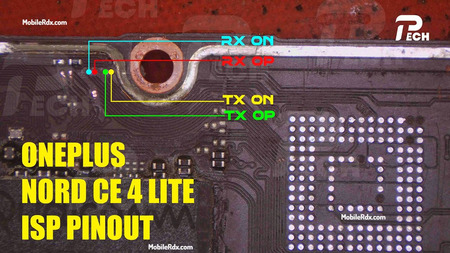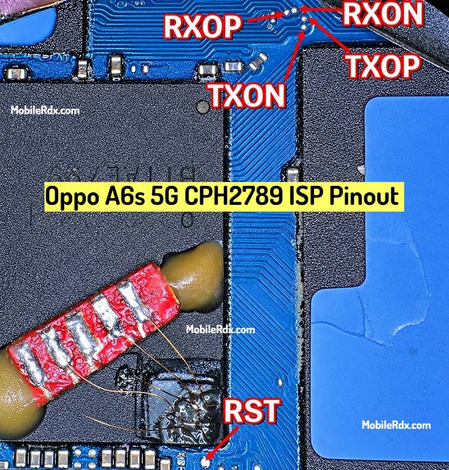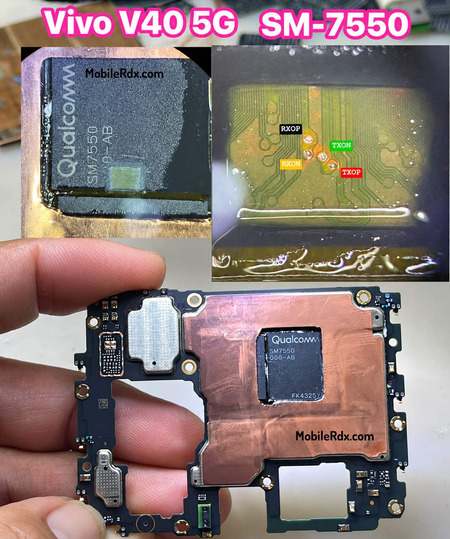

If you are searching for the working Oppo Reno 14 Pro UFS ISP pinout, you are at the right place. The Oppo Reno 14 Pro (CPH2739) runs on the MediaTek Dimensity 8450 platform with UFS storage. In this post, we have shared the tested ISP pinout points that work for FRP bypass, dead boot repair, and firmware flashing.
What Is ISP Pinout?
ISP (In-System Programming) lets you access the UFS memory chip directly while it stays soldered on the motherboard. Instead of removing the chip, you connect jumper wires to the correct test points on the board. This method is used to bypass FRP, flash firmware, repair dead boot, or remove user locks — all without desoldering the UFS chip.
Oppo Reno 14 Pro Key Specifications
| Model | Oppo Reno 14 Pro 5G |
| Model Number | CPH2739 |
| Chipset | MediaTek Dimensity 8450 |
| Storage Type | UFS |
| RAM | 12 / 16 GB |
| Display | 6.83-inch AMOLED 120Hz |
| Battery | 6200 mAh |
| Announced | May 2025 |
Oppo Reno 14 Pro UFS ISP Pinout Points
The UFS ISP test points on the Oppo Reno 14 Pro (CPH2739) are located on the PCB near the UFS chip. Below is the ISP pinout layout:
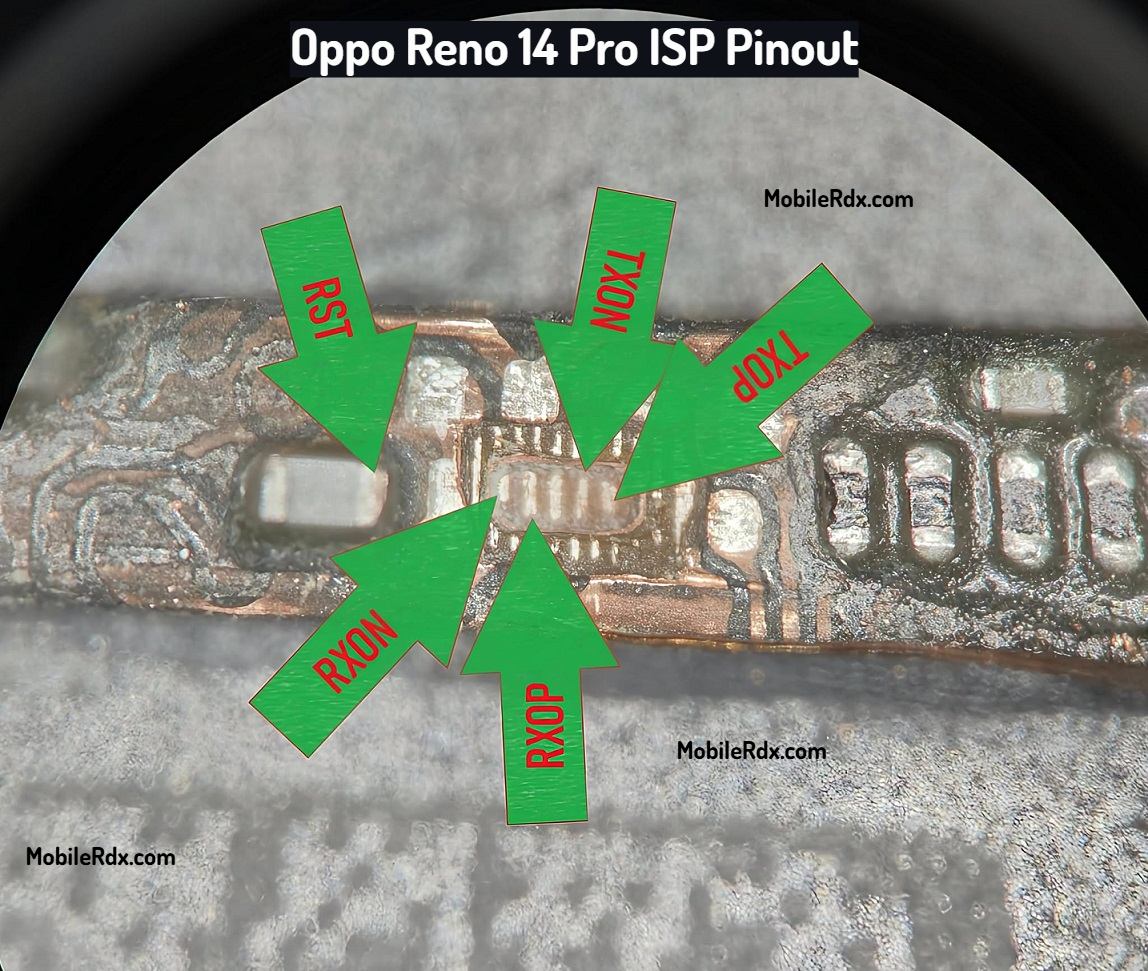
| Pin Label | Function |
|---|---|
| TXOP | Transmit Data Positive |
| TXON | Transmit Data Negative |
| RXOP | Receive Data Positive |
| RXON | Receive Data Negative |
| GND | Ground (connect to any ground point) |
Tools Required
- UFI Box / Easy JTAG Plus / Medusa Pro
- 0.1mm – 0.3mm jumper wires
- Fine tip soldering iron (temperature controlled)
- Soldering flux and leaded solder
- Isopropyl alcohol (IPA 99%) for cleaning
- Multimeter for continuity testing
- Microscope or 10x magnifying lens
How to Connect Oppo Reno 14 Pro UFS ISP – Step by Step
- Remove the battery – Disconnect the battery flex to prevent voltage conflicts and short circuits.
- Remove the metal shield – Use a hot air station to remove the shield covering the UFS chip area.
- Clean the PCB – Use IPA and a brush to clean the area around the test points.
- Identify the test points – Locate TXOP, TXON, RXOP, RXON, and GND near the UFS chip.
- Solder jumper wires – Use a fine tip iron with flux. Keep wires short to avoid interference.
- Verify with multimeter – Check continuity between each point to confirm no shorts.
- Connect to UFI / Easy JTAG – Connect the wires to your ISP tool according to its pinout.
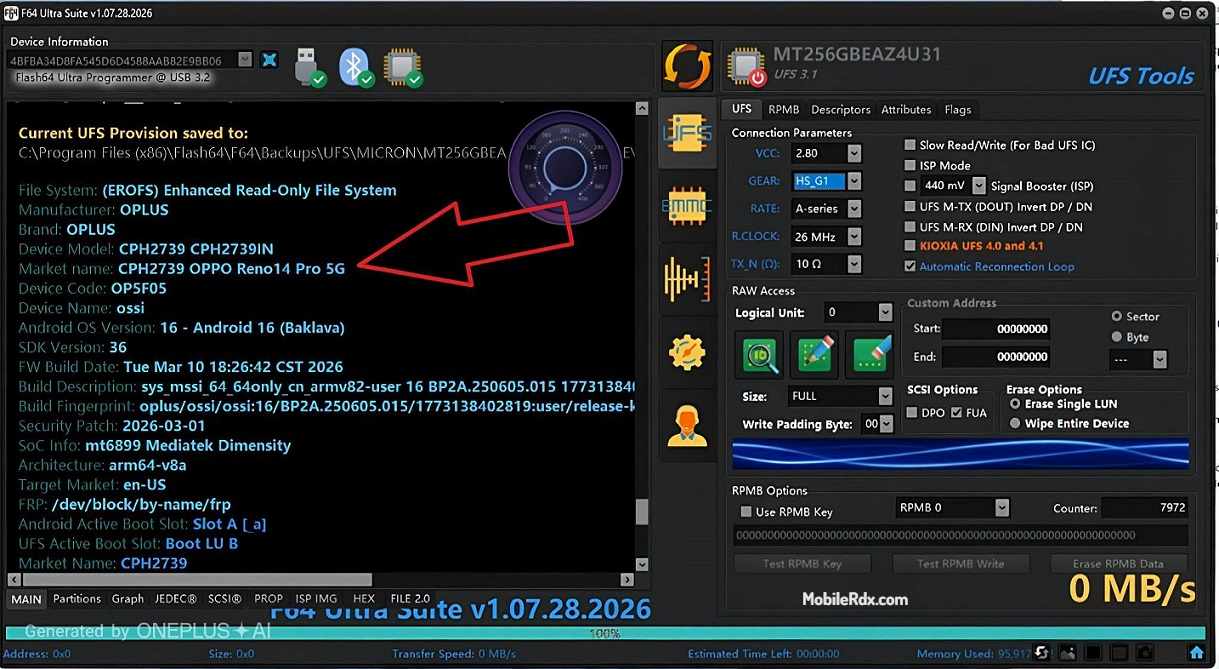
- Identify UFS – Click Identify UFS in the software. Chip info means the connection is correct.
- Perform the operation – Erase FRP, flash firmware, dump UFS, or reset the device.
Common Issues & Solutions
- Tool not detecting UFS: Double-check the TX and RX connections. Try swapping the TXOP/TXON with RXOP/RXON pairs.
- Short circuit detected: Clean the solder area and check for solder bridges with a multimeter.
- Wrong UFS detection: Use UFI v1.8.0.5 or higher for best compatibility with MediaTek Dimensity UFS chips.
Final Thoughts
The Oppo Reno 14 Pro (CPH2739) UFS ISP pinout makes FRP bypass, firmware flashing, and dead boot repair much easier for this model. Work carefully under a microscope, confirm each point with a multimeter, and you will get a successful connection. If you repair this model regularly, keep this image for quick reference.
Frequently Asked Questions
The Oppo Reno 14 Pro (CPH2739) is powered by the MediaTek Dimensity 8450 processor with UFS storage.
Yes. Once connected via ISP, use UFI or Easy JTAG to open User Partition > Special Task > Reset FRP to remove the FRP lock.
UFI Box and Easy JTAG Plus both work well. Use UFI v1.8.0.5 or later for best results with MediaTek Dimensity UFS chips.
No. The UFS ISP test points are accessible on the PCB surface near the UFS chip without drilling the CPU.